

I love teaching an inquiry based curriculum! There is so much room for students to ask their own questions and pursue their own answers.
That being said, it can be easy to get off track or siderailed while teaching an inquiry based program. After all, we still need to cover the standards and assure that learning targets are met. So how do you keep an inquiry on track? What are some structures you can put in place to maintain the focus of your inquiry based curriculum?
Choose essential questions that you love
The first step is to ensure that you and your students are answering essential questions that you truly love; ones that do not have just one right answer and will require deep thought. These questions are your anchor throughout the inquiry; you will keep returning to them again and again!
Don’t remember what an essential question is? Check out this post to read more!

Bookend your inquiry with questions
Launch the unit!
Launch your inquiry based unit with the essential questions! One of my favorite ways to kick off a unit is to simply present my students with our essential questions and gather their initial thoughts. Similar to a KWL chart, I staple the questions to a large piece of chart paper and prompt students to circulate the room to draw and write their ideas.
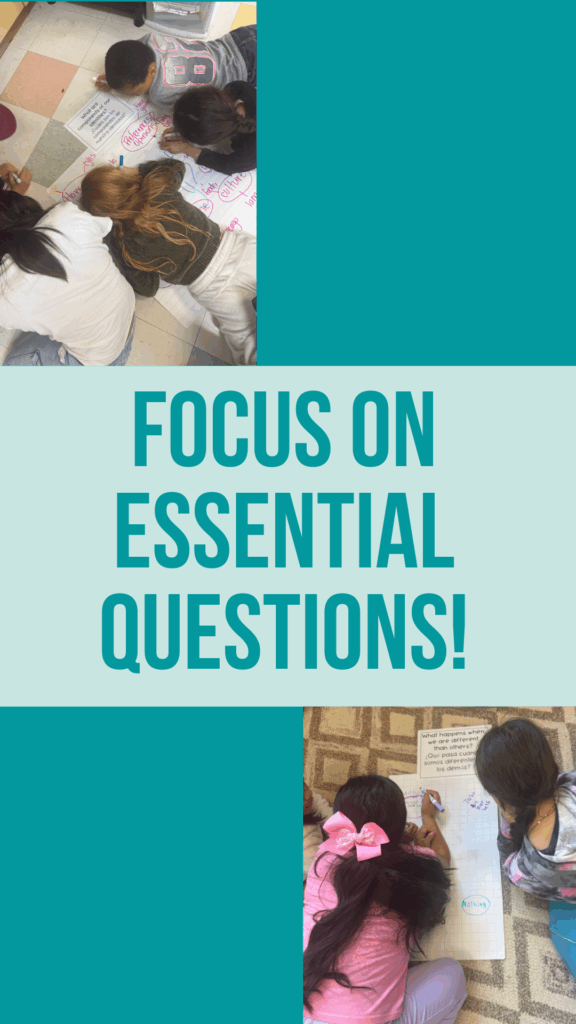
This is meaningful because it sets a purpose for the unit right away. Your students can immediately get talking – and agreeing or disagreeing – about their ideas for how to answer the prompts. This strategy also acts as a sort of pre-assessment for you. You can think:
- How accurate are students’ answers?
- Are there themes/ideas that need to be challenged?
- How can I take students’ current knowledge and really push it to the next level?
Revisit the questions at the close of the unit!
Once the unit comes to a close, revisit those same essential questions! Using the same graffiti walk strategy or another, prompt students to revisit the essential questions. Prompt them not only to answer the questions, but to consider how their thinking has changed, perhaps providing sentence stems like:
- At first, I thought _______, but then ______
- Not only _______, but __________

Keep the essential questions present throughout the unit!
Another great way to keep your inquiry-based curriculum on track is to check in with the essential questions often.
Post the questions!
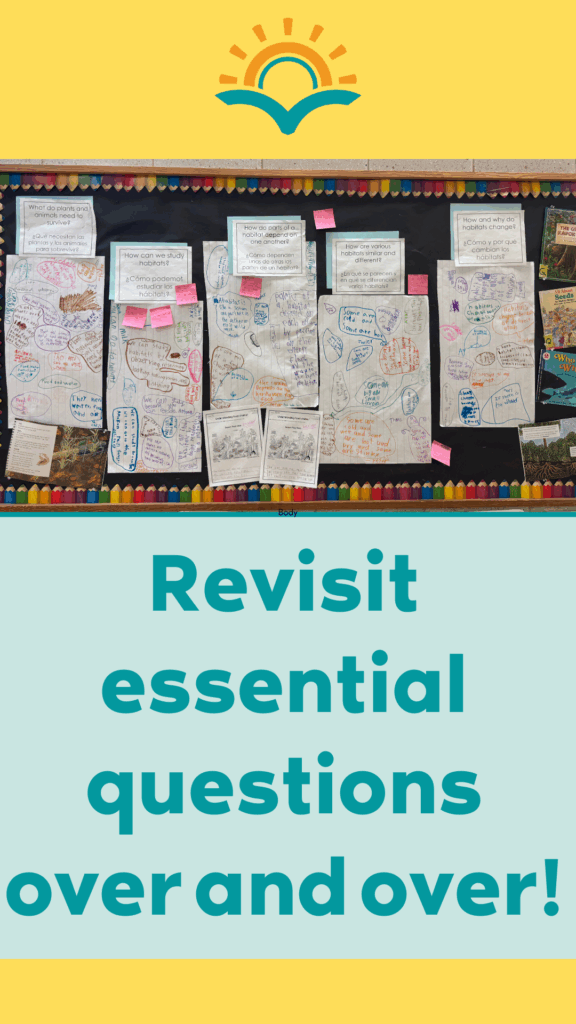
Keep the questions – and students’ initial ideas – posted throughout the unit! I love to create a living “working wall” or “inquiry wall.” These highlight the essential questions and act as a growing scrapbook for learning throughout the inquiry-based unit. Make sure to read more here about what you can include!
Play, “Identify the question!”
Another strategy to maintain focus during an inquiry-based unit is to prompt students to identify the essential question – or questions – they are answering that day. For example, I might introduce a read-aloud and prompt students to identify which of our essential questions is being addressed in that text. Their answers might sound like, “If it’s about the food web, maybe it will answer the question, ‘how are living things related to one another?'” This gives a focus during the read-aloud – and directly aligns your work that day with the unit’s big ideas.
Answers and Questions
I love starting off a new week of an inquiry-based unit with a routine I call “Answers and Questions.” This simple routine shakes off some of the weekend-induced forgetfulness and, hopefully, encourages students to get excited about the learning to happen that week.
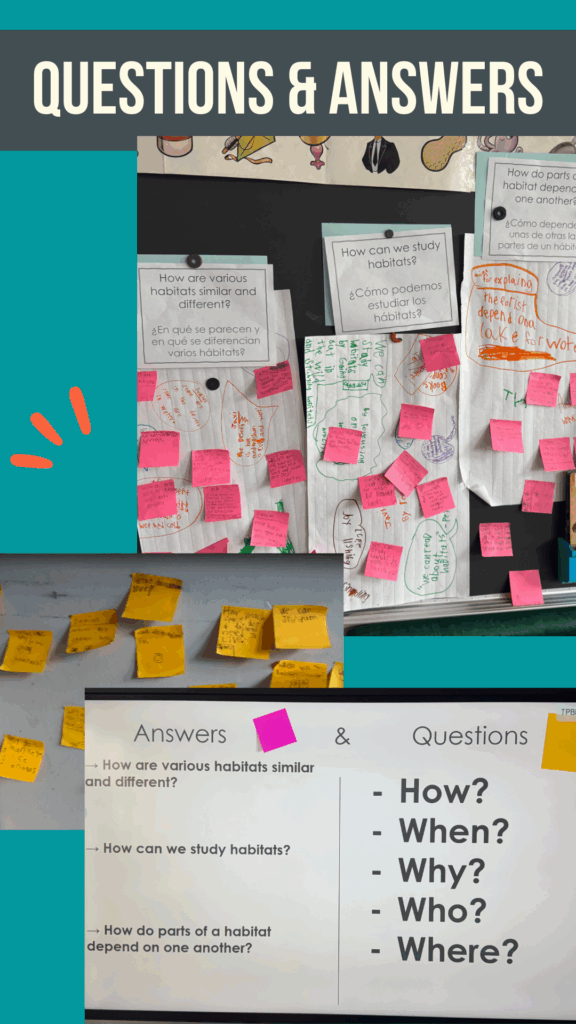
In this routine, I provide students with two colors of sticky notes. I assign one color to be for answers and the other for questions. Students write an answer for one of the essential questions that we addressed the previous week. They also write down a new question that has come up. We then post those answers and questions on their corresponding essential questions. It’s so satisfying to see students able to answer questions – and exciting to see their growing curiosity!
Individual Conferencing
Another great way to stay on track in your inquiry-based curriculum is to hold short 1:1 conferences with students. Truly, these needn’t be more than 4-5 minutes long, but they can give you great insight into how the student is progressing with the unit. You can ask questions like:
- What have you learned so far in this inquiry?
- What questions do you have that you hope we’ll still answer?
- What videos or texts have been most helpful for you?
- How can we make this inquiry even more interesting?

I hope you enjoyed these ideas to keep your elementary inquiry based curriculum on track! Please read more from Kate:
- Creating visual displays of learning: living bulletin boards!
- Poems by Amanda Gorman that are ideal for cross-curricular learning!
