

Idioms show up everywhere—in storybooks, hallway conversations, test directions, and even classroom routines. But for English Language Learners (ELLs), these colorful expressions can quickly become confusing, even frustrating. If you’ve ever seen a student pause at a phrase like “spill the beans” or “hit the books,” you know just how puzzling idioms can be without the right support.
In this post, we’ll dig into why idioms are so tricky to learn, look at a few idiom examples, and explore practical, ELL-friendly strategies that actually work to teach idioms meaning. Let’s dive in!

Why are idioms difficult to learn?
Idioms are tricky for one simple reason: they don’t mean what they say. Unlike most vocabulary, idioms can’t be decoded word by word. A student might know the words “kick” and “bucket” but still have no clue what “kick the bucket” means (and may even take it literally!). For students learning English, especially those still mastering sentence structure and word meanings, idioms can feel like riddles with no clear answer.
On top of that, idioms are deeply tied to culture, humor, and shared context—things ELLs might not have been exposed to yet. When native speakers use idioms fluently in conversation, it can feel like a secret language that ELL students aren’t in on. That’s why explicit, thoughtful instruction is key. Idioms aren’t just vocabulary—they’re a bridge to understanding how native speakers really use language. Teaching idioms in a clear, predictable way is one of the best ways to support your English Language Learners!

What are some idioms examples?
If you’re wondering which idioms are worth teaching, start with the ones your students are most likely to hear at school or see in books. Here are a few examples of common classroom and everyday idioms and their meanings:
- “A piece of cake” – something very easy
- “Break the ice” – to start a conversation
- “Hit the books” – to study
- “Under the weather” – feeling sick
- “Hold your horses” – wait or be patient
- “Spill the beans” – to share a secret
- “The ball is in your court” – it’s your decision
Even simple expressions like “hang in there,” “cut it out,” or “on the same page” can be confusing without some guided support. Explain what these mean explicitly!
The good news? Students love learning these once they catch on. Idioms are playful, expressive, and add color to language—which makes them perfect for interactive, engaging lessons.

How can we teach idioms well?
The best way to teach idioms is to make them visual, contextual, and fun. Here are a few strategies that help idioms stick (without making students feel overwhelmed):
1. Teach idioms meaning in context, not isolation.
Rather than handing out a list of idioms to memorize, introduce them through stories, read-alouds, or classroom conversations. Ask students to infer the meaning based on what’s happening in the sentence. For example:
“Jorge had a big test tomorrow, so he decided to hit the books after dinner.”
Then guide students to figure out that “hit the books” doesn’t mean hitting anything—it means studying.
While many common idioms will come up organically, it is also advisable to create a clear, consistent routine to center idiomatic expressions in your classroom. I’ve developed a yearlong, 36-week scope and sequence that covers the 72 most commonly used idioms – please check it out here! It includes everything from a common idioms list to teaching slides and 72 printable idioms worksheets – all you need to explicitly teach idioms all year long!
2. Co-create visuals—silly is allowed!
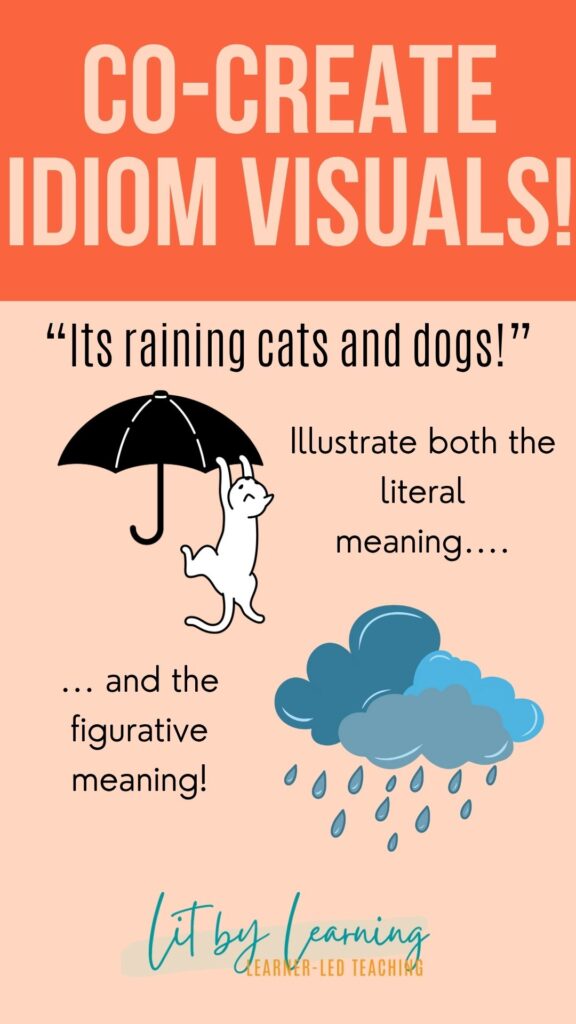
Work together with your students to draw both the literal and figurative meanings of each idiom. For “it’s raining cats and dogs,” craft a picture of animals falling from the sky and a drawing of a big storm. After some practice, invite students to draw their own idioms drawings and then share out with the class. Laughter and playfulness makes learning stick!
3. Make space for practicing idioms in conversation and writing!
Encourage students to use idioms in real speech. Role-play, journal prompts, and idiom charades are great tools. Idioms worksheets can help students practice reading and writing with the idioms. The more students practice using idiomatic expressions, the more natural they’ll become.

4. Practice idioms meaning consistently.
The hard truth? If we as teachers are not intentional about teaching idioms, this meaningful ELL practice often falls to the wayside. The solution? Use consistent systems to keep idioms at the forefront of your class!
Take notes on new idioms!
As you introduce new idioms, prompt students to add them to a Language Notebook. In here, they can draw the literal and figurative meanings of each idiom and include a sentence demonstrating the idioms meaning.
Create a classroom display or center to practice idioms!
When the class learns a new idiom, post them on a bulletin board with student-created definitions and drawings or add them to a literacy center. Provide students with opportunities to review them regularly in partnerships and small groups!
5. Tie in idioms from other languages.
Many ELLs come from rich linguistic backgrounds where idioms also play a big role. Invite students to share idioms from their home languages and compare meanings. This creates a culturally responsive space where all languages are valued!

Here are some examples of English and Spanish idioms with similar meanings:
- Cost an arm and a leg / Cuesta un ojo de lar cara – is very expensive.
- Don’t judge a book by its cover / Las apariencias engañan – don’t judge on appearance alone
- Miss the boat / Se le pasó el tren – miss an opportunity
- Beat around the bush / andarse por las ramas – waste time by not getting to the point
Keep reading about teaching idioms meaning!
- Check out a sample lesson plan for teaching idioms from Colorin Colorado
- Read about even more strategies to teach idioms meaning!
- Check out this blog post for more ideas for explicit language instruction for ELL students!