
You have English Language learners in your class and want to provide them with the very best. You want to teach grade-level content while also supporting rich language development. This article highlights three sheltered instructional strategies for English Language Learners that are incredibly effective. They are all strategies that you can use with no knowledge of your students’ home language – no direct translation! Read on to learn about the teaching strategies, why they work, and how you can implement them in your classroom today!

What are sheltered instructional strategies for English Language Learners?
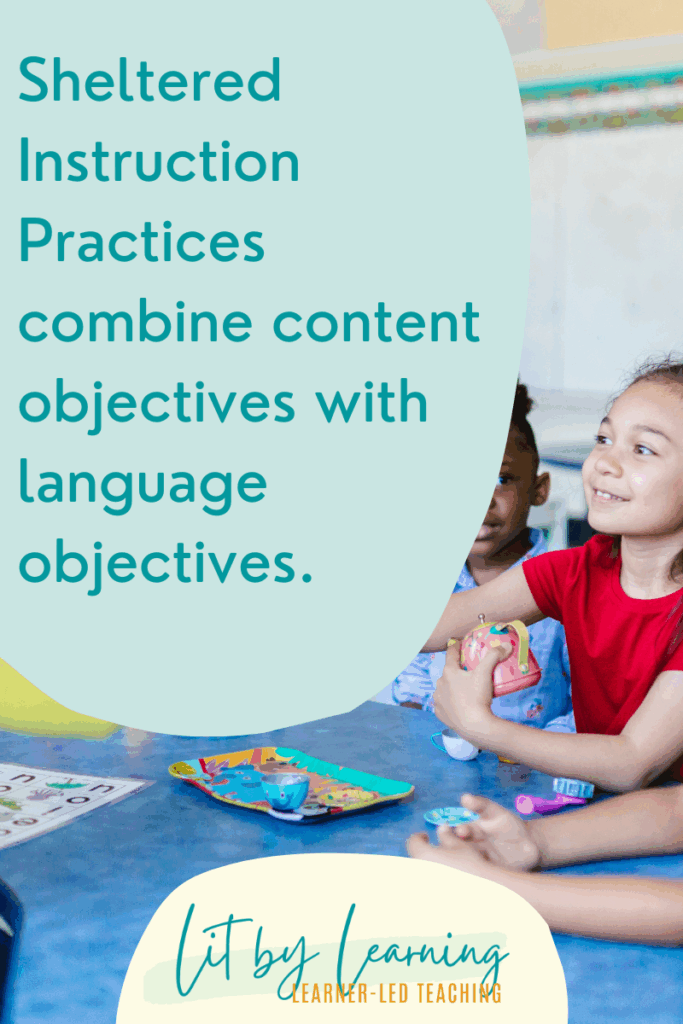
Sheltered instruction is a teaching approach designed to make academic content more accessible to English Language Learners (ELLs) while promoting their English language development. It integrates language objectives with content objectives.
This can mean using techniques like visual aids, hands-on activities, scaffolding, and cooperative learning to help ELLs master grade-level material. Teachers using sheltered instruction also may modify their speech, clarify key vocabulary, and check for understanding frequently. These teacher moves ensure that ELLs can participate fully in content-based lessons while improving their English proficiency.
The goal is to provide a supportive, engaging environment where students can develop both content knowledge and language skills simultaneously.
Sheltered Instructional Practices vs other ELL teaching Strategies
Sheltered instruction differs from other ELL strategies in its dual focus on teaching academic content and supporting language development within the same lesson. These strategies are for general education teachers to use in their classrooms.
Sheltered instruction strategies differ from ESL pull-out programs, which remove students from the mainstream classroom. They’re also different than push-in language-only supports. In both of these models, the focus is on solely language skills. In contrast sheltered instruction happens in the content classroom and integrates subject learning (like science or social studies) with targeted language support.
Sheltered Instruction is also distinct from newcomer programs, which often emphasize survival English and cultural orientation for students new to the country. Sheltered instruction is typically used with intermediate to advanced ELLs and aims to bridge the gap between language proficiency and academic success, while many other strategies prioritize foundational language acquisition or social language use.
3 proven sheltered instructional strategies for English Language Learners
Strategy 1: Inside/Outside Conversation Circles
🎯The strategy: In the Inside/Outside Conversation Circles strategy, the teacher provides a clear question to the class. The question should incorporate both a language component and a content component. For example, the teacher may present the question: “What do animals need to survive?” In this science-based question, students also practicing using the academic vocabulary word (habitat).
Once the question is presented and think time is provided, the teacher splits the students into two circles: one inside, the other outside. One circle group asks the question (written on the board); the other group answers the question. Midway through, the groups can switch. Learn more details here!
❓Why it works: This strategy focuses on structured opportunities to use new or academic language. It works for English Language Learners because they are supported by prompts and explicit instructions: it is clear what they are practicing. It also give repeated changes for practice – they get to try again and again. Finally, this is an effective instruction strategy for language learners because they are not singled out: everyone in the classroom is practicing new learning at the same time.
✅ How to implement it: Make this strategy your own by using it across content areas. Working in your math block? Students can ask/answer the question: What numbers create a sum of 16? There are many possible answers and it benefits everyone to practice the academic vocabulary (sum) AND practice multiple addition iterations to equal 16. Focusing more on English Language Arts? Following a read-aloud, your focus question could be, “How would you characterize _____?”
Instructional Strategy 2: Total Physical Response (TPR)
🎯The strategy: In the Total Physical Response (TPR) strategy, the teacher and students work cooperatively to create a physical motion to represent a word or idea. For example, they may decide that when they talk about comparing and contrasting, they’ll form a double circle Venn Diagram with their fingers. Or perhaps they choose that two hands pushing from the body will represent “disperse.” The classroom community stays consistent with their motions
Learn more details here!
❓Why it works: This second strategy works especially well for English Language Learners because it connects language to movement, making new vocabulary and commands more concrete and easier to remember. By physically responding to spoken directions—such as pointing, jumping, or acting out a verb—students engage their bodies and minds, which strengthens comprehension and retention.
Total Physical Response reduces the pressure to speak before students are ready, allowing them to build listening skills and confidence in a low-stress, playful environment. It also supports kinesthetic learners and helps bridge language gaps without requiring translation, making it an ideal strategy for multilingual classrooms
✅ How to implement it: Once again, this instruction strategy for English Language Learners is applicable across content areas. Choose one part of your day to try it out. I find it’s easy to start with social studies or science, where there is often lots of new vocabulary to learn and practice. That said, this instructional practice will work for any subject!

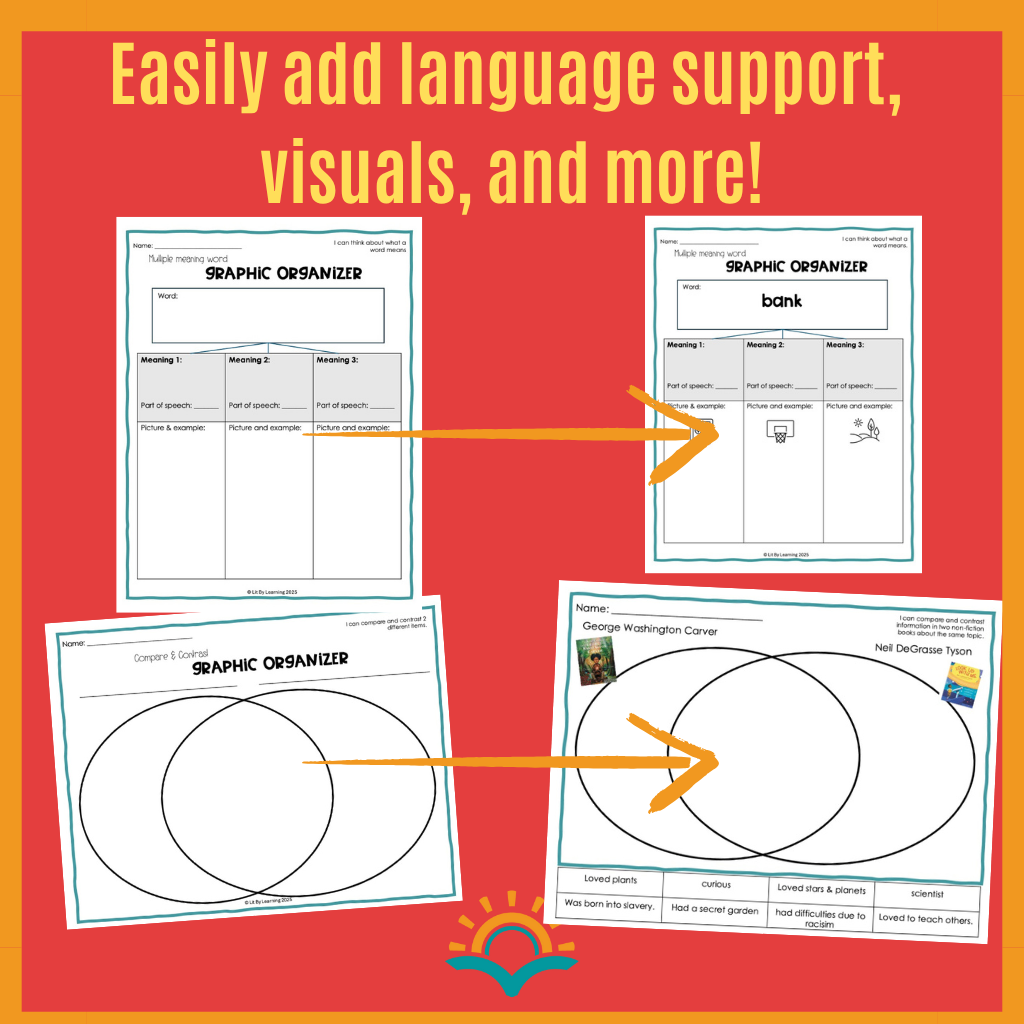
ELL Instructional Strategy #3: Clear visuals & consistent graphic organizers
🎯The strategy: While this final ELL teaching strategy may seem obvious, take a moment to consider the following scenario.
A multilingual student is working on learning how a bill becomes a law. There’s so many new vocabulary words to learn and the process seems unclear. Then, their teacher shows them a clear, illustrated flowchart. It looks almost exactly like the one they used in science class to explain how a seed grows into a full tree. The first steps are on the right, then go in order to the left! The flowchart has pictures that are screenshots from an instructional video they watched in both English and Spanish. It contains icons that correlate directly with the anchor chart on the board: one for each branch of the US government. Things start to crystallize!
This ELL instructional strategy is not only about using visuals, but being incredibly deliberate about using consistent formats and predictable icons.
❓Why it works: We all know that a picture is worth a thousand words & that visuals can communicate clearly no matter the language. We recognize that many of our students are visual learners.
Pictures, real-life objects (realia) and effective visuals help all students, but are especially critical to those learning content and language side-by-side.
✅ How to implement it: With this strategy, it’s important to not let perfection get in the way of good enough. Often times, your hand-drawn sketches or color-coded arrows are just as good – or better – than images you can spend way too long searching for online. Be consistent with how you represent cross-curricular concepts: perhaps a star for main idea or story moral, a thought bubble with a question mark in it to frame up questions.

Also: your students can provide visuals much of the time! You’ll often hear me say, “What could we sketch here to help us remember this?” and then inviting a student to put their idea on the board or anchor chart. Read more about using consistent visual aids in your classroom here!
Even more sheltered instructional strategies for English Language Learners!
I hope that the instructional strategies highlighted above can find a space in your classroom. Remember: you don’t need to make changes all at once. Small, consistent supports are so impactful for your English Language Learners! I’ve listed even more ideas of sheltered instructional strategies for English Language Learners below!
- Adapt content (e.g., text, assignments) to language proficiency levels
- Plan meaningful activities (e.g., simulations, models, role plays) that integrate lesson concepts with language practice opportunities.
- Explicitly link concepts to students’ backgrounds and lived experiences
- Explicitly link past learning and new concepts.
- Use speech appropriate for students’ proficiency level (e.g., slower rate, enunciation, and simple sentence structure for beginners).
- Explain and model academic tasks clearly.
- Ample opportunities for students to apply and practice the content with language supports.
- Frequent opportunities for interaction and discussion.
- Ample opportunities to use native language (L1)/ strategic use of L1 – even if you’re not fluent!
Keep learning about Sheltered Instruction!
Curious to learn about more instructional strategies for English Language Learners? Check out some of my favorite places to go for inspiration and classroom ideas:
- Colorin Colorado: Read more about Sheltered Instruction Strategies and other instructional models for ELLs here!
- Edutopia: Read here for more information about Sheltered Instruction Observational Protocol!
