

The underestimated teaching strategy for ELLs
When we talk about effective teaching strategies for ELLs, one key principle often gets overlooked: consistency. Not just in expectations or classroom routines (though those matter, too), but in the design, structure, and delivery of instructional materials.

For English Language Learners, simply navigating new content in a second language is a cognitively demanding task. Adding unnecessary variables can create confusion. These variables such as shifting elements like visual formats of work, inconsistent schedules, or unpredictable routines. While well-intentioned, we can accidentally create a classroom experience that can feel more like a puzzle than a pathway to learning.
Let’s unpack why consistent routines and materials matter and how you can use this low-prep, high-impact strategy to support ELLs every day.
What Is Cognitive Load—And Why Should Teachers Care?
That’s where consistency comes in.
Cognitive load refers to the amount of working memory used while learning something new. All students experience it. But for ELLs, the load is significantly heavier—they’re decoding new vocabulary, grammar rules, pronunciation patterns, and content all at once.
When we introduce materials with varying layouts, icons, instructions, or structures, we unintentionally add to that already high load. Students now have to spend mental energy simply figuring out how to engage with the resource, leaving fewer cognitive resources for understanding what they’re learning.
Predictability: an ignored teaching strategy for ELLs
Predictable materials don’t mean boring materials and they certainly don’t mean “dumbing down” content!
Predictability for your ELL students means that they know where to look, what to do, and how to respond—because the format stays the same.
Consistency means that your students already have a firm grasp on methods and structures that remain constant so they can focus more mental energy on the new learning.
Here’s what consistency can look like in practice in your elementary classroom:
- Areas around the room that serve the same purpose all year. For example, a bulletin board where the relevant math vocabulary words are always posted. Likewise, an area where you keep dictionaries that students can use throughout the days.
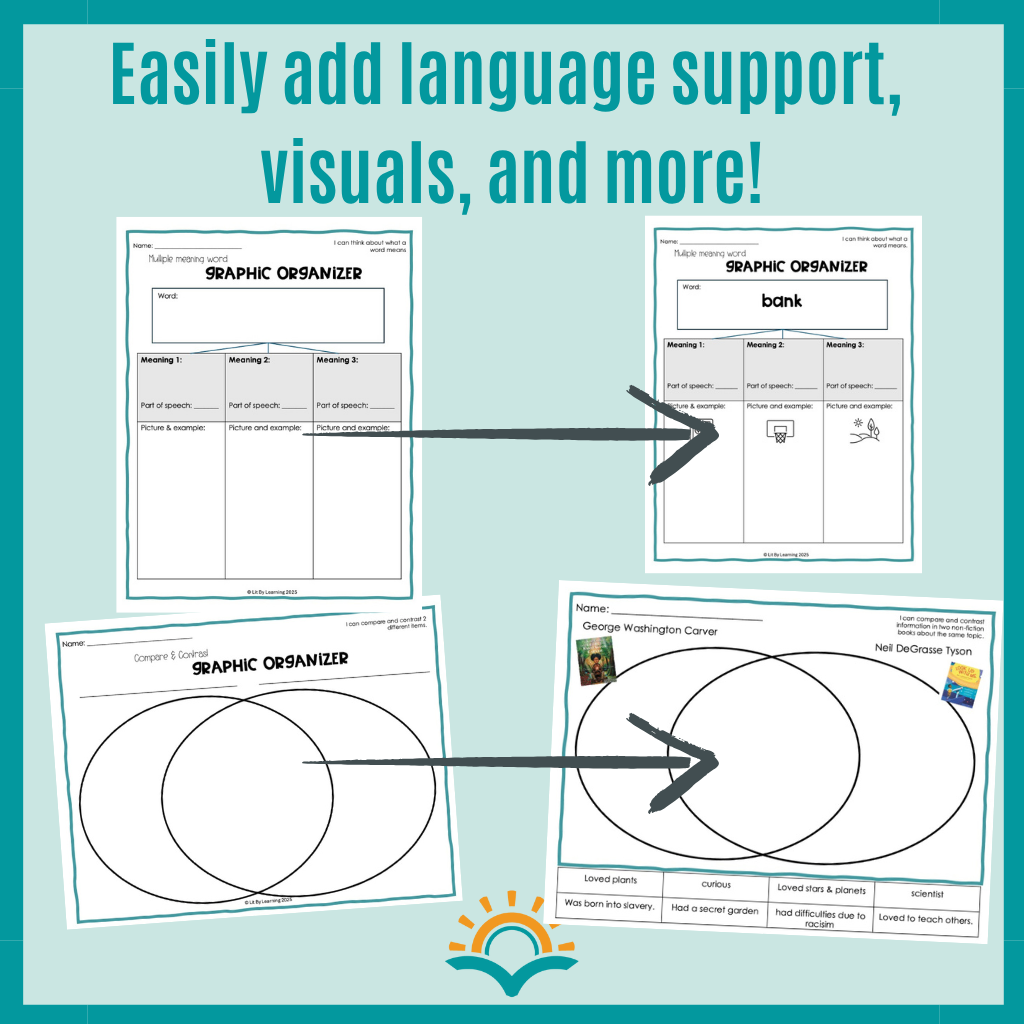
- Graphic organizers with identical layouts and language support across subjects. For example, teachers can provide a Venn Diagram with accompanying comparison language sentence starters, whether the activity is in math or reading!
- Word walls and posters that follow a color-coded system (e.g., blue for English, green for Spanish). This can be especially powerful for students practicing translanguaging!
- Instructional routines that follow a repeatable process: model > guided practice > independent practice or exploration/inquiry > research > reporting. Read more about my consistent process for initiating student-led inquiries here!
- Visual or Physical cues that are used consistently to represent directions or procedures. Visual cues can include icons or emojis (✏️ = write, 🎧 = listen, 🔍 = find). Physical cues can be hand or body motions that represent an idea. Read more about this second strategy, also called Total Physical Response, here!
These kinds of structures build confidence and frees up your ELL students to focus on what matters most: making meaning from content and language.
With consistency, your ELL learners can anticipate what’s expected. They gain autonomy and can start to flourish.
Teaching Strategies for Ells: Consistency counts!
Reducing cognitive load for your multilingual learners isn’t about simplifying learning. It’s about clearing the path so that English Language Learners can fully engage, participate, and thrive in academic spaces.
By committing to consistent materials, processes, and routines, you’re not just organizing your classroom—you’re giving students the tools to access language, make connections, and build confidence in their ability to learn.
When we make learning predictable, we make it possible.
