If you’re teaching English Language Learners (ELLs), you know how quickly a simple word can turn into a stumbling block. Imagine learning that “watch” can be both a thing on your wrist and something you do with your eyes. Or that “light” can describe a lamp, a feather, or the absence of seriousness.
These are called multiple meaning words or homonyms, and they can be especially tricky for ELLs who are still building vocabulary, context clues, and confidence. In this post, we’ll talk about why they’re so important—and share easy multiple meaning words and engaging activities for multiple meaning words you can start using today.
What Are Multiple Meaning Words?
Before diving into strategies, let’s clearly define multiple meaning words: They are words that look and sound the same but have two or more unrelated meanings. They can also be called homonyms.
Examples include:
- Bat (an animal / a tool for hitting a ball)
- Ring (a piece of jewelry / the sound a phone makes)
- Right (a direction / something correct)
These words are common in everyday English, which means students encounter them all the time—in classwork, read-alouds, and social conversation.
Why Are Multiple Meaning Words Challenging for English Language Learners (ELLs)?
ELLs often learn language in chunks or patterns. When a word like “trip” suddenly shifts from meaning a vacation to a fall, it disrupts their understanding. Without enough context, students may:
- Misinterpret questions
- Struggle with comprehension
- Avoid using words they don’t fully understand
By intentionally teaching the different meaning of words, we empower ELLs to be more confident, flexible communicators. Read more here!

Start here: Easy Multiple Meaning Words Examples
Begin with simple, familiar words your students already use in speech. Here are a few easy multiple meaning words that are perfect for elementary ELLs:
| Word | Meaning 1 | Meaning 2 |
|---|---|---|
| Bark | Sound a dog makes | Outer layer of a tree |
| Bat | Flying mammal | Baseball equipment |
| Watch | To look at something | A timepiece |
| Light | Not heavy | Something that shines |
| Rock | A stone | To move back and forth |
Teaching Multiple Meaning Words
There are two main ways to teach multiple meaning words to your elementary students. The first is an imbedded method, the second is an explicit, pre-planned method.
Imbedded Multiple Meaning Words Instruction
In this first method, the teacher addresses multiple meaning words as they arise in context. This could be during read-alouds, small group reading lessons, and even during specific subjects like science, social studies, and math.
This method is meaningful because students learn about the homonym in context. They are already reading the text and have motivation to make sense of the word so that they can make better sense of the whole text.
The disadvantage to this method is that stopping to discuss a mutliple meaning word can disrupt the flow of a lesson, possibly distracting students from the main objective. This way of teaching homonyms can also be difficult because students can easily forget these words. Without a place to record the word and its multiple meanings, like on an anchor chart or an individual journal, these mini-lessons can fall to the wayside.

Explicit Instruction of Multiple Meaning Words
In this second method of instruction, the teacher creates a plan for explicitly teaching multiple meaning words and allots specific time to focus on this skill with their students. There are many ways to organize a plan: based on words students will encounter in a shared text or going from the most commonly used MMW’s to less commonly used ones.
The upside to this form of instruction is that it crystal clear in its focus: during the allotted language/word work time, the students’ only job is to distinguish the various meanings of multiple words. This lessens their cognitive load: instead of focusing on both the content and the word meanings, they can zoom in on just one idea at a time. This method is also more conducive to setting up an effective classroom routine for keeping track of words. Teachers can post a simple growing anchor chart or bulletin board or can set up a routine of students adding newly-defined words to a journal.
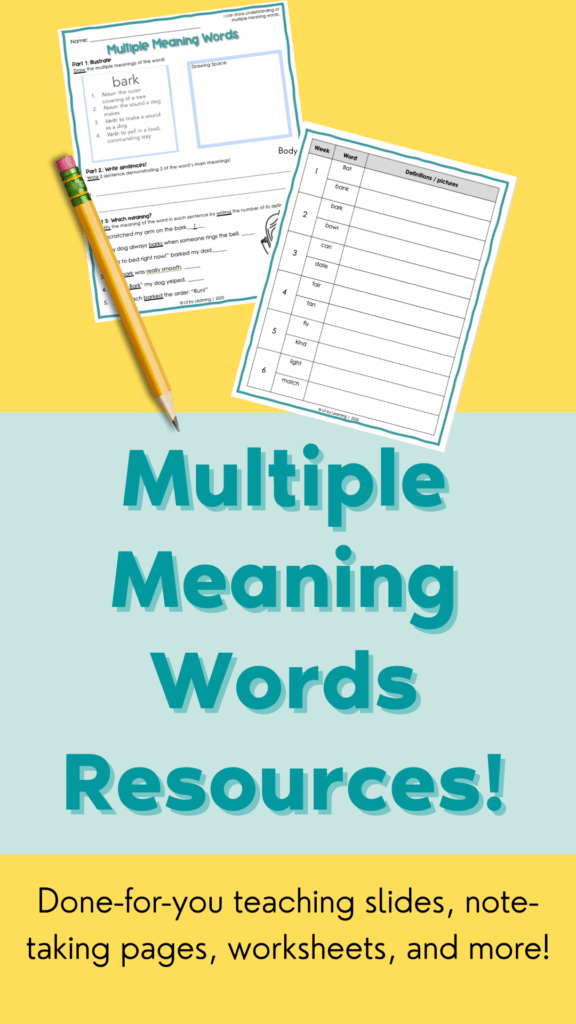
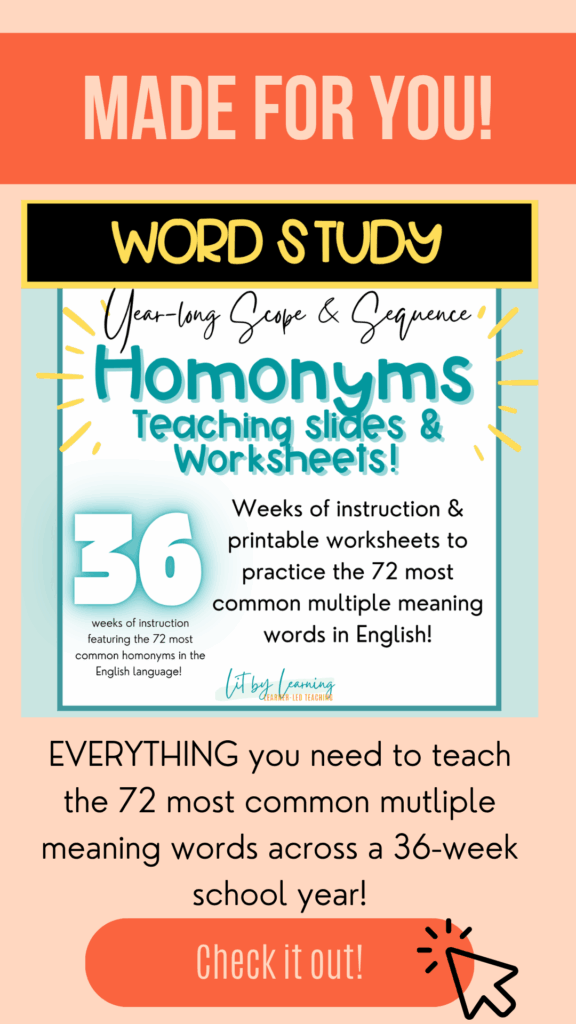
Looking for a comprehensive way to teach the 72 most common multiple meaning words throughout the school year? Please check out my homonym resource here!
Which method for teaching Multiple Meaning Words should I use?
Both! Effective teachers will use both the Imbedded and Explicit Instruction methods to ensure their students have the skill to unlock multiple meaning words!
Fun & Effective Activities for Multiple Meaning Words
Here are a few activities for multiple meaning words that are hands-on and language-rich:
1. Draw the Difference
Students fold a paper in half and draw both meanings of the word. For example, one side shows a bat flying, the other shows a bat at home plate. This supports visual learners and encourages discussion.
2. Act It Out
Call out a multiple meaning word and have students silently act out each meaning. (e.g., “ring” – mime calling someone and then pretend to put on a ring.)
3. Sentence Sorting
Provide students with simple sentences using multiple meaning words. Prompt them to work in groups or as individuals as they sort the sentences into two categories based on meaning. This is great as a small group or literacy centers activity!
4. Partner “Teach and Test”
Each student picks a multiple meaning word and teaches their partner both meanings—then creates two fill-in-the-blank sentences to quiz them. Another version of this is to have students use their notes of previously learned words to quiz a friend.
5. Meaning Match-Up
Give students cards with words on one set and definitions or pictures on the other. Mix and match until they’ve paired all meanings with the right word! This can be done as a type of puzzle (match word to pictures or definitions) or as a Memory Game where students need to make groups of three.

Conclusion: Turning Homonyn Confusion into Confidence
The more we define multiple meaning words and explore their use in context, the more we equip our ELLs with tools for decoding language, clarifying meaning, and expressing themselves with precision.
Don’t underestimate the value of taking time to explore the different meaning of words—even the simplest ones. A single word might just be the bridge to stronger comprehension and more meaningful participation in the classroom.
Get started now! I’ve designed a scope and sequence to teach the 72 most common homonyms over a 36-week school year! Access this comprehensive multiple meaning words resource here!