

Are you curious about cross-curricular unit design? Perhaps you’ve already read about the 6 must-haves for a quality inquiry-based unit, but want to see the nitty-gritty, behind the scenes details. You’re in the right place! Read on to see how my teaching team blends International Baccalaureate elements with standards to create an engaging inquiry-based unit of study centered around the Sharing the Planet theme.

Introduction to the Sharing the Planet Unit
Welcome to our second-grade Sharing the Planet inquiry-based unit! In this inquiry, students explore the connections between plants and animals while also learning about important cycles in nature. In my school, we usually conduct Sharing the Planet as our 5th of the 6 total inquiries of the year. By this time, the second grade students have conducted 2 previous research projects and have practiced presenting in front of peers several times. Their writing skills are also ready for complete paragraphs!
International Baccalaureate (IB) Info:
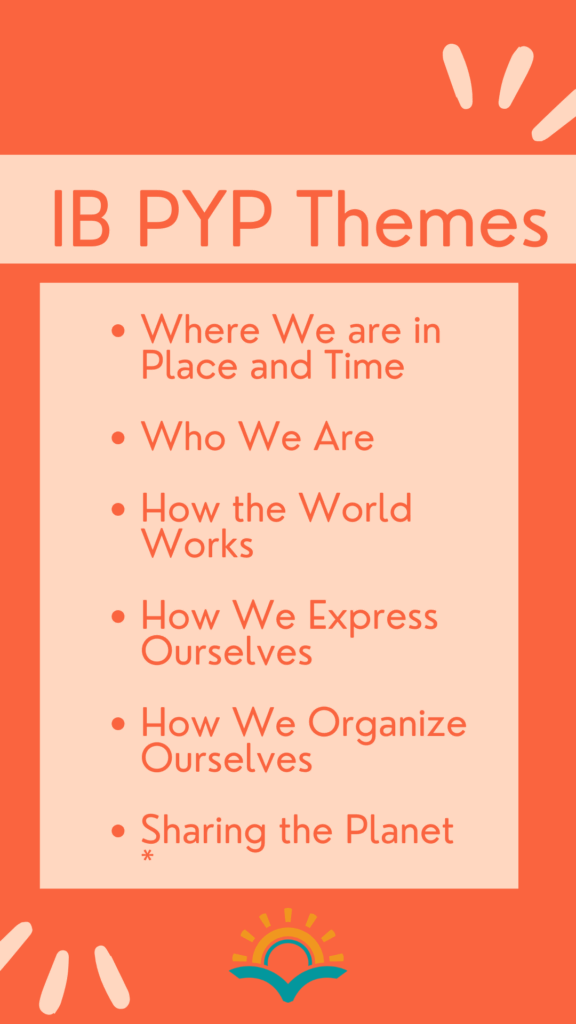
International Baccalaureate Primary Years Programme teachers (like me!) center each of the year’s inquiries on one of the following themes:
- Where We are in Place and Time
- Who We Are
- How the World Works
- How We Express Ourselves
- How We Organize Ourselves
- Sharing the Planet *this is the theme of this inquiry!
Central Idea: Living things interact within habitats
IB teachers also center their instruction around a central idea, key & related concepts, lines of inquiry, and learner profile attributes:
Key Concepts: Function, Causation, and Connection
Related Concepts: Biodiversity, patterns, impact, supply/demand, interdependency, sharing resources
Lines of Inquiry:
- An inquiry into the diversity of life in a habitat
- An inquiry into the function of plants and animals within a habitat
- An inquiry into the interdependency of living things
Learner profile attributes: Knowledgeable, communicator, inquirer

Essential Questions
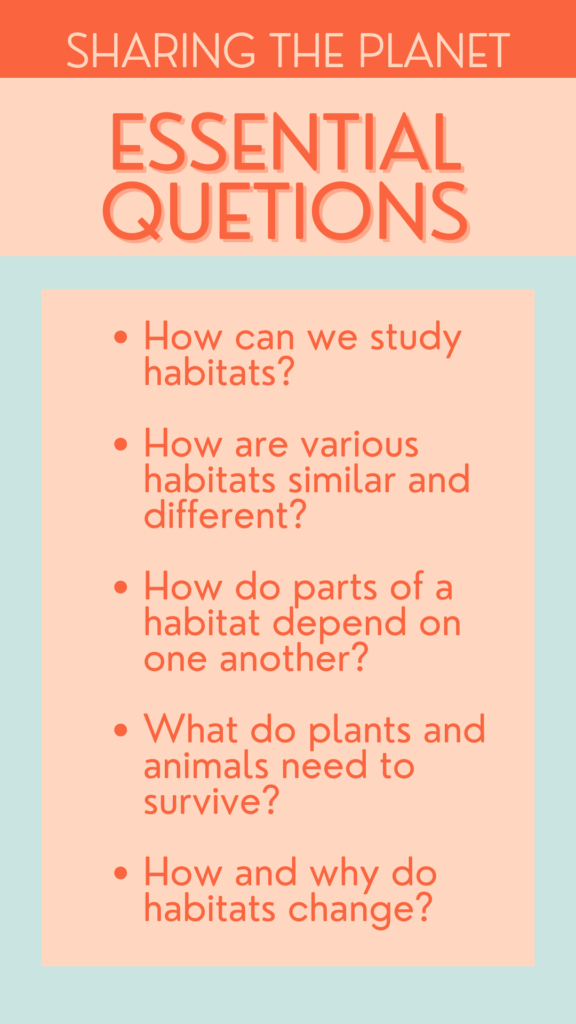
Essential questions are critical to an IB Inquiry Unit. These huge, unanswerable questions guide the learning for the inquiry cycle. You can think of them like checkpoints on a map. Here are the essential questions we explore in this Sharing the Planet Unit:
- How can we study habitats?
- How are various habitats similar and different?
- How do parts of a habitat depend on one another?
- What do plants and animals need to survive?
- How and why do habitats change?
Sharing the Planet: Key Standards
All IB inquiries are cross-curricular: they explore concepts across the disciplines. Here are the focus standards for our Sharing the Planet inquiry:
Science (NGSS) Standards:
K-2-ETS1-1. Ask questions, make observations, and gather information about a situation people want to change to define a simple problem that can be solved through the development of a new or improved object or tool.
2-LS4-1. Make observations of plants and animals to compare the diversity of life in different habitats. .
2-LS2-2. Develop a simple model that mimics the function of an animal in dispersing seeds or pollinating plants.*
Reading Standards:
CCSS.ELA-LITERACY.RI.2.1: Ask and answer such questions as who, what, where, when, why, and how to demonstrate understanding of key details in a text.
CCSS.ELA-LITERACY.RI.2.2: Identify the main topic of a multiparagraph text as well as the focus of specific paragraphs within the text.
CCSS.ELA-LITERACY.RI.2.4: Determine the meaning of words and phrases in a text relevant to a grade 2 topic or subject area.
CCSS.ELA-LITERACY.RI.2.5: Know and use various text features (e.g., captions, bold print, subheadings, glossaries, indexes, electronic menus, icons) to locate key facts or information in a text efficiently.
CCSS.ELA-LITERACY.RI.2.6: Identify the main purpose of a text, including what the author wants to answer, explain, or describe.
Writing Standards:
CCSS.ELA-Literacy.W.2.2:Write informative/explanatory texts in which they introduce a topic, use facts and definitions to develop points, and provide a concluding statement or section.
Speaking and Listening /Listening Standards
CCSS.ELA-Literacy.SL.2.2: Recount or describe key ideas or details from a text read aloud or information presented orally or through other media.
CCSS.ELA-Literacy.L.2.3: Use knowledge of language and its conventions when writing, speaking, reading, or listening.
Math Standards:
CCSS.MATH.CONTENT.2.NBT.B.7: Add and subtract within 1000, using concrete models or drawings and strategies based on place value, properties of operations, and/or the relationship between addition and subtraction; relate the strategy to a written method. Understand that in adding or subtracting three-digit numbers, one adds or subtracts hundreds and hundreds, tens and tens, ones and ones; and sometimes it is necessary to compose or decompose tens or hundreds.
CCSS.MATH.CONTENT.2.G.A.1: Recognize and draw shapes having specified attributes, such as a given number of angles or a given number of equal faces.1 Identify triangles, quadrilaterals, pentagons, hexagons, and cubes.
CCSS.MATH.CONTENT.2.G.A.2: Partition a rectangle into rows and columns of same-size squares and count to find the total number of them.
CCSS.MATH.CONTENT.2.G.A.3: Partition circles and rectangles into two, three, or four equal shares, describe the shares using the words halves, thirds, half of, a third of, etc., and describe the whole as two halves, three thirds, four fourths. Recognize that equal shares of identical wholes need not have the same shape.
Other Standards:
- IL State Social Studies Standards: SS: SS.EC.1.2: Demonstrate how our choices can affect ourselves and others in positive and negative ways
- Learning for Justice Standards: Justice – 13. Students will analyze the harmful impact of bias and injustice on the world, historically and today.
Sharing the Planet Learning Experiences and Assessment
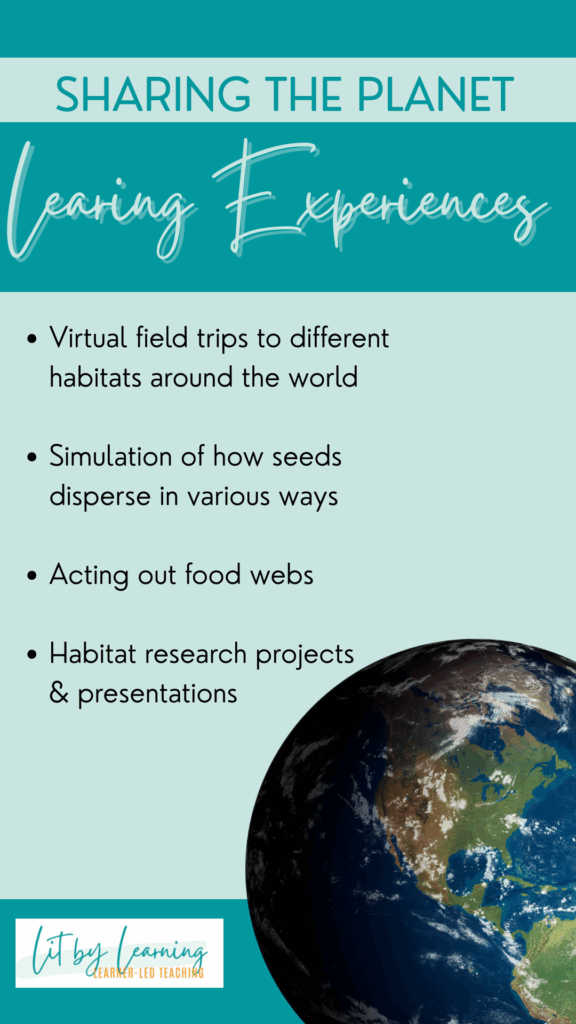
Our Sharing the Planet unit includes plenty of hands-on learning opportunities. We loosely follow the CKLA Amplify Science Curriculum – Plants and Animal Relationships. From this, we draw simulations about seed dispersal, ideas about journal-writing about a designated outdoor space, and the experience of growing our own variety of plants in class.
Students are also challenged to engage in their own Habitat Research project. In this project, students can choose from a selection of habitats from around the world. From there, they conduct research in books and online to gather information about the description of the habitat, the plants and animals it is home to, and at least 1 energy/food chain it hosts.
Students have a variety of options about how they can share out their learning. They are invited to write a non-fiction book, create a Google Slides presentation, design a poster, or create a 3D model/diorama – or to suggest another creative idea for teacher approval.
Read more!
Wondering how to keep an extended inquiry like this on track? Read this article for some classroom structures to stay goal-oriented the whole unit long!

